

Keyword research is a crucial part of developing your digital content strategy. You must grasp your potential customers’ intentions and how they align with your offerings. There are short-tail keywords, like ‘crayons’, and long-tail keywords, such as ‘coloured crayon sets’ or query terms like ‘what’s the best coloured crayons for children?’.
The type of keywords you should target depends on your product or service. It’s obvious that the keyword should make sense – if you sell paint, not crayons, you should exclude crayon-related keywords. N.B. if there is a high volume intent for crayons and it fits with your business type, consider this a useful nugget of information for range planning.
Let’s start with the basics for now.
Numerous free tools are available that list commonly searched terms. You can simply Google it!
Every website owner has access to Google Analytics and Search Console. Google Analytics provides a list of searched keywords, both short and long-tail, primarily for bidding on paid ads. You can also use this list for your on-site content strategy. Search Console offers similar insights under ‘Performance’ and ‘Queries’, showing keyword impressions (how often your site appears in searches). Note that impressions don’t necessarily mean clicks.
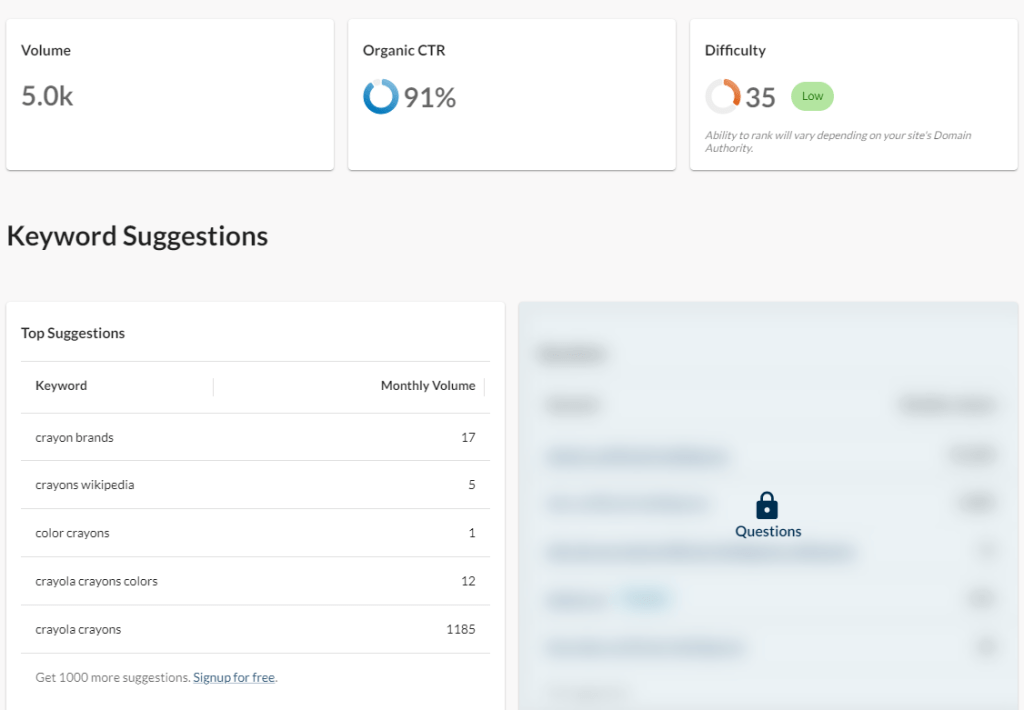
Other free tools limit the number of keywords you can explore per day and require you to specify the type of keywords you’re interested in. For example, Moz offers three free keywords per day. In the screenshot below you can see search volume, click-through rates, and the difficulty of ranking for each term. It also suggests the top five terms to target, but it’s advisable to Google those terms yourself to assess ranking difficulty.
For long-tail query-related keywords, Google itself is a great starting point. Pay attention to ‘People Also Ask’ questions, which are highly searched terms. Analyse who ranks for these terms and how they answer them.
Paid tools are invaluable for comprehensive keyword research. They provide data on search terms’ performance for your business, the impact of changes to your site, and competitor performance. Most keyword research tools also offer insights into how your targeted search terms perform for your competitors.
How and where you use the keywords that you have identified is key to increasing your visibility in Google and other search engines. If you wish to know more and would like me to help you build a content strategy that helps you do that, contact me via email at josmithtoday@gmail.com.
 DIGITAL TODAY - Digital Marketing Consultant
Leave a comment