
You’ve probably noticed Google’s catchy new TV ads showcasing something called Gemini. It’s the AI that’s now integrated into Google’s platforms, popping up in Chrome, on Chromebooks, and mobile devices. But what does it mean for your online business?
You might be wondering how this new feature will impact your website’s traffic. Will AI-generated answers decrease clicks to your site? How will this affect your organic performance? And what about search ads—will they still be effective on these new SGE pages? These are all valid questions, and while we don’t have all the answers yet, Google’s Search Generative Experience (SGE) is still in its early stages and will evolve over time.
The good news is that Google has reassured us that driving traffic to websites remains a priority, and search ads will continue to be a “native part of SGE.”
How Will Search Engine Results Pages (SERPs) Change?
Let’s explore how Google plans to honour these promises and what SGE might mean for businesses of all sizes.
SGE is an experimental version of Google’s search engine that uses AI to generate contextual answers to more complex questions. Imagine a search result page that looks like this:
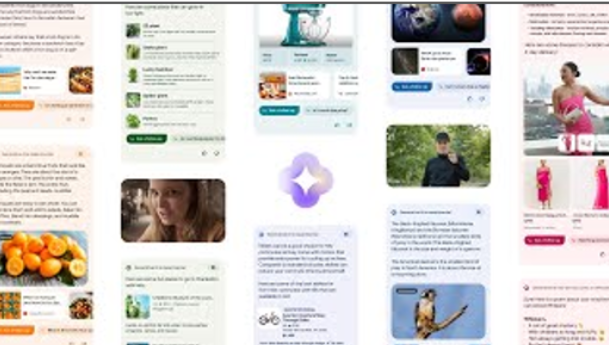
SGE enhances the search experience in three key ways:
1. AI Snapshot: Generates a concise summary for longer, more complex queries.
2. Conversational Mode: Allows for follow-up questions while retaining the context of your original search.
3. Vertical Experiences: Provides detailed product information and features, particularly in commercial searches.
Now, let’s break down each of these components.
What Makes Up Google’s Search Generative Experience?
These features are designed not only to provide faster, more accurate answers but also to encourage users to explore online content.
AI Snapshot
SGE uses AI to create a unique response to your multi-faceted query, pulling information from multiple sources. Google calls this an “AI Snapshot.”
The idea is to give a brief answer to complex, long-tail questions, such as “What’s the best restaurant for a family with peanut allergies in Central London?”
However, SGE isn’t intended to answer your query and send you on your way. Google has emphasised that it still aims to drive traffic to web content. “As we integrate generative AI into Search, we’re committed to continuing to send valuable traffic to sites across the web.” Whether this holds true remains to be seen.
One way Google plans to keep the clicks coming is by displaying three links prominently to the right of each snapshot, complete with eye-catching thumbnails.
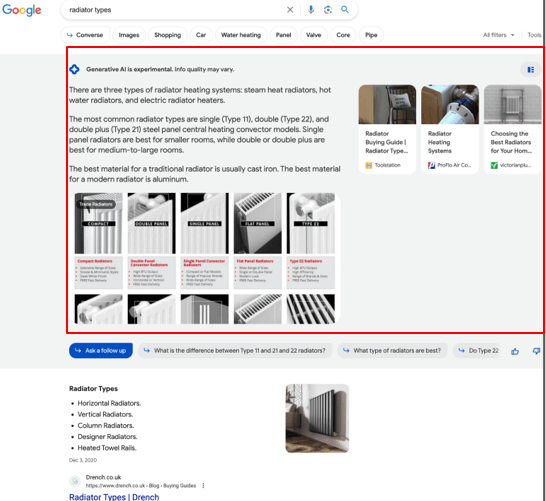
Every sentence in these snapshots is backed up by an external source, which is crucial since other AI tools, like Bard, have had issues with accuracy.
**In summary**: SGE introduces a different search experience, which could cause fluctuations in both paid and organic results, impacting your rankings, traffic, and cost per click.
Conversational Mode
Conversational Mode lets users ask follow-up questions while keeping the context of the original search. By tapping “ask a follow-up” or one of the suggested next steps under the snapshot, users can engage in a more interactive conversation with the AI.
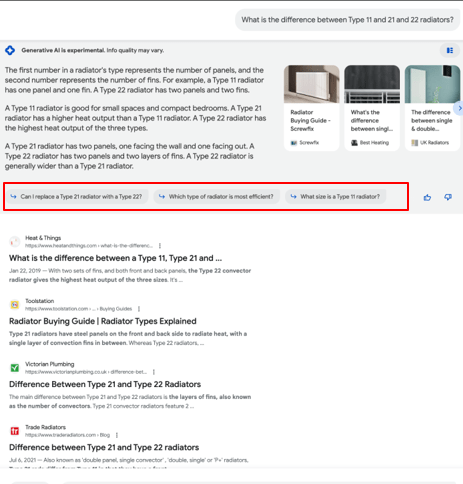
In summary: The fact that product links appear during conversational searches presents a significant opportunity for businesses. By optimising your content for these types of searches, you could potentially attract more qualified traffic.
Vertical Experience
From a commercial standpoint, this is where many businesses will focus their attention. SGE enhances vertical searches—such as shopping and local business searches—particularly when the queries are multi-dimensional.
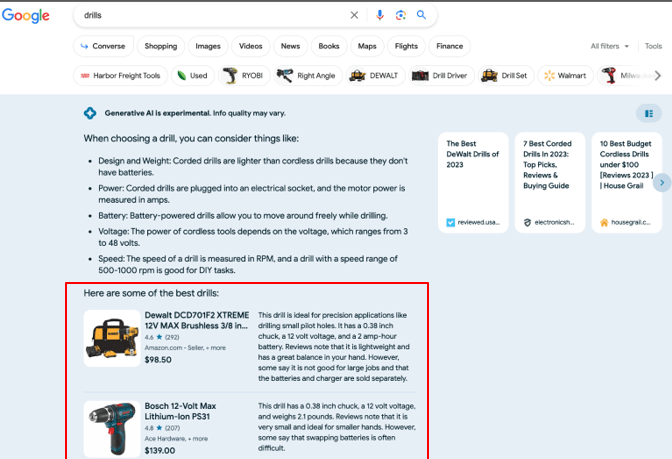
For example, a search that clearly has commercial intent will trigger SGE to prepare a list of potential products. Each product option includes an AI-generated description, reviews, prices, and a thumbnail. Tapping on one option reveals a larger image, along with store locations, prices, and stock availability.
In summary: Shopping suggestions aren’t new for Google, but how they integrate with AI snapshots will be interesting to see. My immediate recommendation is to ensure your images are polished and compelling enough to encourage clicks. Additionally, make sure your landing page descriptions are engaging and well-crafted to stand out from the competition. This will require thorough testing.
Perspectives – Coming Soon!
Perspectives will appear as both a filter and a dedicated section, though it might not launch immediately as it’s still being tested. This feature presents a feed of user-generated content, such as videos, images, and written posts from discussion boards, Q&A sites, and social media.
While you may not have direct control over this content like you would with a product or service description, you can still influence your brand’s reputation. Encourage customer reviews, engage positively with comments on social media, and embrace the opportunity to connect with your audience.
What Does Google’s Search Generative Experience Mean for My Business?
Google has said that they will “test and evolve the ads experience as we learn more.” So, expect changes as SGE continues to develop.
Here are some implications for businesses:
Ads will be positioned differently…
Google has shareholders to please, so it’s unlikely that SGE will reduce visibility for paid ads. According to Google, “ads will continue to appear in dedicated ad slots throughout the page.” In fact, a sneak peek at one commercial query result shows ads positioned at the top of the page, above the AI-generated snapshot.
For transparency, Google labels these links as “Sponsored.” These ads are from existing campaigns, and at present, advertisers cannot opt out.
Potential Loss of Organic Traffic
There’s a risk that the new interface could reduce organic traffic by prioritising AI-generated answers. The AI snapshot occupies a significant portion of the mobile screen, meaning users may have to scroll to see the traditional 10 blue links.
While source links may still drive some traffic, we don’t yet know how many clicks they’ll attract. And there’s little information on how to optimise for these new features.
Moreover, as Google aims to make SGE do the “heavy lifting” for searchers, there’s concern that users might rely on AI-generated results rather than visiting the source websites.
Less Traffic, Higher Conversion
On the bright side, this could lead to higher conversion rates for both SEO and paid traffic. If a shopper can refine their search before clicking through, they’re likely to be a more intent-driven buyer by the time they reach your site. In this case, SGE acts like a personal shopper, giving users an overview of what’s available.
What Can I Do to Prepare?
1. Brace yourself: There will be turbulence, and organic traffic is likely to be the most affected.
2. Consider a slush budget: Have some extra funds ready for PPC to support any fluctuations in organic traffic.
3. Get customer reviews: If you don’t have genuine reviews on your site, start encouraging them now.
4. Embrace social media: Even if your CEO doesn’t get it, social media needs to become your best friend.
SGE is still an evolving feature, and while it presents challenges, it also offers opportunities for those who are prepared. By staying adaptable and keeping an eye on these developments, you can position your business to thrive in this new search landscape. I’m remaining very close to this topic as it develops so if you need support to help navigate these huge changes, contact me via email at josmithtoday@gmail.com.
 DIGITAL TODAY - Digital Marketing Consultant
Leave a comment